VALORANT Champions Shanghai Group Stage Day 8 Recap
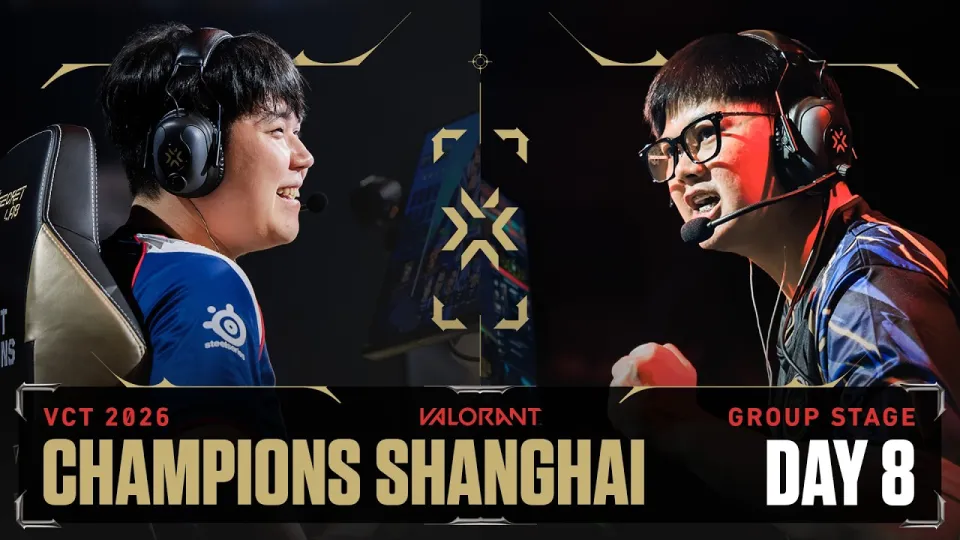
Video: VALORANT Champions Shanghai — Group Stage — Day 8
Want articles like this for your own video to promote it on YouTube and Google? Order them through the Telegram bot @sat_sit_bot. Articles with your video embedded are written and posted by the bot itself — on popular topical sites (no ads). Free trial — 50 articles.
· based on the channel VALORANT Champions Tour
Key takeaways
- Day 8 of the VALORANT Champions Shanghai group stage features a full T1 vs JD Gaming series plus an earlier match on the broadcast.
- The stream runs roughly four and a half hours, with Game 1 of the opening series starting around the 35:56 mark.
- A technical pause interrupts the first game between 1:15:49 and 1:16:51.
- T1 vs JD Gaming is decided across three maps: Game 1 at 2:37:45, Game 2 at 3:48:17, Game 3 at 4:28:42.
- All four Chinese representatives are eliminated before the playoff bracket, sparking debate about regional slots and the CN region's standing.
VALORANT is a 5v5 tactical shooter from Riot Games in which two teams fight over a spike, economy and map control across attack and defense halves. At the highest level it becomes the VALORANT Champions Tour, and the Shanghai Champions event is the season's biggest trophy. Day 8 of the group stage, published by the VALORANT Champions Tour channel on 2 October 2026, is the day the bracket starts to sort contenders from tourists — and the day the host region runs out of teams. You can follow the official bracket and schedule updates via VALORANT Esports on X.
What happened on Day 8 of the Shanghai group stage
Day 8 delivered two series and a long broadcast that ends with the tournament's first real culling. The headline series is T1 against JD Gaming, played across three maps, with the earlier match filling the first part of the stream before the Korean-Chinese clash takes over. The broadcast structure is easy to follow even without commentary: Game 1 of the opening series starts around the 35:56 mark, a technical pause eats two minutes between 1:15:49 and 1:16:51, and the T1 vs JDG series occupies the back half of the VOD — Game 1 at 2:37:45, Game 2 at 3:48:17 and the decider at 4:28:42.
What makes the day notable is not the schedule but the outcome. The result leaves the host region without a single team in the playoff picture, which turns a routine group stage day into the most argued-about broadcast of the event so far.
T1 vs JD Gaming and the map that got away
The most repeated takeaway from Day 8 is that JD Gaming had a genuine path to a 2-0. JDG built a 6-11 lead on the opening map, a position that would have been an almost unheard-of result for a Chinese team against a top-tier international opponent. Instead the lead evaporated, the map flipped, and the series stretched to a third game where JDG's level dropped sharply. That collapse is the single biggest "what if" of the day.
The third map tells the other half of the story. JDG were not just beaten on individual aim; they were out-structured once T1 settled into their preferred tempo, and the deficit compounded round after round. For a roster that had shown real preparation on the first map, losing the decider that decisively is the kind of result that gets remembered longer than the scoreline suggests.
Individual performances and role questions
Individual form dominated the post-match discussion. One recurring theme was T1's use of a player long associated with a support or initiator role being fielded on a duelist — a decision that raised eyebrows but also reflected how flexible modern compositions have become. On the JDG side, the conversation was harsher: one standout player was described as carrying four passengers, which is a familiar pattern for teams whose star has to open every site alone.
A few micro-moments also drew attention. A silenced Crown ultimate was singled out as one of the most satisfying interactions of the match, and a disputed hit registration — a shot that appeared to connect with an Omen but registered as fewer bullets than viewers counted — became a talking point about server-side hit confirmation versus what the spectator client shows. That gap between what the broadcast displays and what the game registers is a normal artifact of observing a live server, not evidence of a broken mechanic.
Technical pauses, observer quirks and broadcast notes
The broadcast itself had its own talking points. A technical pause in the first game lasted roughly a minute, from 1:15:49 to 1:16:51, and the observer occasionally lingered on loadout screens and lineup practice between rounds. Viewers also noted the venue atmosphere — the arena was repeatedly described as library-quiet, a stark contrast to the noise usually associated with a home crowd at a Champions event. Whether that is acoustics, audience composition or the mood of a region watching its last team fight for survival is open to interpretation, but it changed how the matches felt on stream.
None of this affects competitive integrity. Pauses are standard in a broadcast of this length, and observer decisions are made in real time by a production team juggling multiple perspectives.
Why the CN region's elimination is the real story
All four Chinese teams are out of the group stage, and that fact has reframed the entire event. The criticism is blunt: the region received direct slots and did not convert them into playoff appearances, and some viewers argue the slots would be better spent by merging CN back into the wider Pacific pool. The counterargument is equally direct — the "regional curse" framing is a myth, and most teams simply play better at home because of crowd support, travel and routine. Chinese teams were not uniquely cursed; they were not ready for the level of the international field.
Both positions contain something true. Slot allocation is a structural question about growing a region, while performance is a competitive question about the current rosters. Day 8 is the moment those two questions collided on stream.
What Day 8 means for the rest of Champions Shanghai
With the host region gone, the bracket now belongs entirely to Americas, EMEA and Pacific contenders, and every remaining series carries more weight for seeding and momentum. T1 advance with a series win that was messier than the scoreline implies, which matters because the playoff field punishes slow starts far more than a group stage does. JDG leave with a first map they should have closed and a third map they would rather forget.
The wider lesson is about preparation depth. Teams that can adapt mid-series — swapping roles, changing tempo, resetting after a lost lead — are the ones still alive. Teams that rely on one player to generate every opening pick are not.
Useful links
- Official VALORANT Esports updates: https://x.com/valorantesports
- Facebook: https://www.facebook.com/ValorantEsports/
- Instagram: https://www.instagram.com/valorantesports/
- TikTok: https://www.tiktok.com/@valorantesports
- Twitch: https://www.twitch.tv/valorant
Final thoughts on the Shanghai group stage
Day 8 is the point where Champions Shanghai stopped being a showcase and became a reckoning. T1 survived a scare, JD Gaming let a winnable series slip, and the host region exited before the playoffs for reasons that are more about readiness than fate. The technical pause, the quiet arena and the disputed hit registration are footnotes; the elimination of four teams from one region is the chapter heading. For the full match-by-match record, the VALORANT Champions Tour channel is the source of the broadcast, and following the official accounts at https://x.com/valorantesports is the fastest way to keep up with the bracket as it narrows.
Questions & answers
Did JD Gaming really have a chance to win 2-0 against T1?
Yes. JDG held a 6-11 lead on the opening map, which would have been an unusually strong result for a CN team on the international stage. They failed to close it out, the map flipped, and the series went to a third game where JDG fell apart. That lost lead is the defining moment of their tournament.
Why were all the Chinese teams eliminated in the group stage?
The short answer is readiness rather than a curse. Slot allocation gave CN direct representation, but the rosters could not match the adaptation speed of Americas, EMEA and Pacific teams in mid-series. Several viewers argue the region would develop faster competing in a merged Pacific pool, while others point out that home-region pressure and travel advantages cut both ways.
What was the technical pause during the first game?
A technical pause stopped play for roughly a minute, from the 1:15:49 mark to 1:16:51 in the broadcast. Pauses like this are routine in long tournament broadcasts and are handled by the production and officiating team; they do not indicate anything about the match result.
Why did a shot on Omen show fewer bullets than viewers counted?
The spectator client reconstructs what happened on the live server, and its hit confirmation can lag or render differently from the actual server-side calculation. Viewers counting three impacts while the HUD shows two is a known observation artifact, not a gameplay bug that changes the outcome of a round.
Source: VALORANT Champions Shanghai — Group Stage — Day 8 · Markdown version